Food · 3 min read
Why Does Dog Food Last 12 to 24 Months? The Truth About Kibble Shelf Life
Dog food can last 12 to 24 months, but fresh meat spoils in days. Learn how kibble is made, what meat meal means, and why preservatives are used in dog food.
By Sheena Sankhla, Senior Manager - Brand Communications · Updated
Independent veterinary and platform review pending
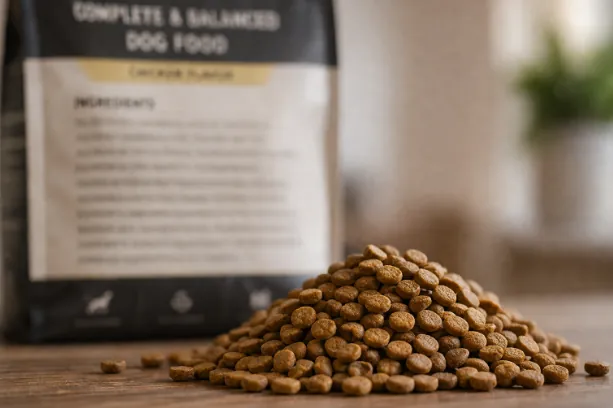
A practical, awareness-first guide for pet parents who want to understand what goes into their dog’s bowl
Most dog food can sit on a shelf for 12 to 24 months.
But fresh meat spoils in a matter of days. So how does something made from meat last this long?
Take a Look at Your Dog’s Food Packet
Check the expiry date.
12 months?
18 months?
Sometimes even longer.
Now pause for a second.
Fresh meat does not last this long. So what makes packaged dog food, especially dry kibble, so shelf stable?
This is not about right or wrong. It is about understanding what goes into your dog’s bowl.
Why Does Dog Food Last So Long?
Shelf life does not just happen. It is engineered.
Most dry dog food, commonly known as kibble, is made using a process called extrusion.
Ingredients are mixed and exposed to high heat and pressure before being shaped into kibble. This process helps eliminate harmful bacteria and allows the product to remain stable for months.
But it also changes the food.
High heat processing can affect natural enzymes and some nutrients. Research in pet food manufacturing shows that certain vitamins can degrade during these stages.
This does not make the food unsafe, but it does mean the final product is not the same as its original ingredients.
What Is Meat Meal in Dog Food?
When reading dog food labels, you will often see terms like chicken meal or meat meal.
These are not the same as fresh meat.
Meat meal is produced through a process called rendering, where animal materials are cooked at high temperatures to remove moisture and fat. What remains is a dry, concentrated protein ingredient used in many dog food formulations.
While widely used, this process changes both the structure and nutritional profile of the original ingredients.
In simple terms:
It is not fresh meat. It is a processed ingredient designed for longer shelf life.
Why Are Preservatives Used in Dog Food?
Fats and oils naturally go rancid over time.
To prevent this, many commercial dog foods include preservatives such as BHA and BHT. These help slow down oxidation and extend shelf life.
These additives are regulated and used within approved limits.
But their presence highlights an important point:
Long shelf life requires preservation.
Why Does Kibble Still Taste Good to Dogs?
High heat and processing do not just affect nutrients. They also impact taste and smell.
To make kibble more appealing, manufacturers often add:
Fats and oils
Flavour coatings
Antioxidants
Added vitamins and minerals
This helps maintain consistency in taste and nutrition across batches.
In other words, the food is formulated for stability and predictability, not freshness.
What Does Shelf Stable Dog Food Really Mean?
Shelf stable dog food typically means the product has been:
Processed for safety and uniformity.
Dehydrated to remove moisture.
Preserved to prevent spoilage.
Nutritionally adjusted to meet standards
None of this automatically makes it good or bad.
But it does mean one thing:
The final product is very different from its original ingredients.
A Simple Question Worth Asking
For a long time, many pet parents do not look beyond the front of the packet.
Brand names are easy to trust. Labels are easy to overlook.
But once you start reading ingredients, it changes how you see your dog’s food.
Not with fear.
Just with awareness.
The BONN-O Perspective
At BONN-O, we started asking the same questions.
What goes into dog food?
How is it made?
And what does real actually mean?
That curiosity is what drives us to look deeper, beyond labels, beyond claims, and into the actual ingredients.
Conclusion
At the end of the day, the question is not which brand you choose.
It is this:
What do you actually know about what your dog is eating?
Explore Better Food Choices for Your Dog.
Understanding food is the first step.Choosing better becomes easier after that.
Sources and further reading
- Global Nutrition Guidelines (World Small Animal Veterinary Association)